Ohio
Songs :: Traveling Star by James Taylor, Ohio by Neil Young, and Carry Me Ohio by Sun Kil Moon
© C. Davidson


Ohio
Songs :: Traveling Star by James Taylor, Ohio by Neil Young, and Carry Me Ohio by Sun Kil Moon
© C. Davidson
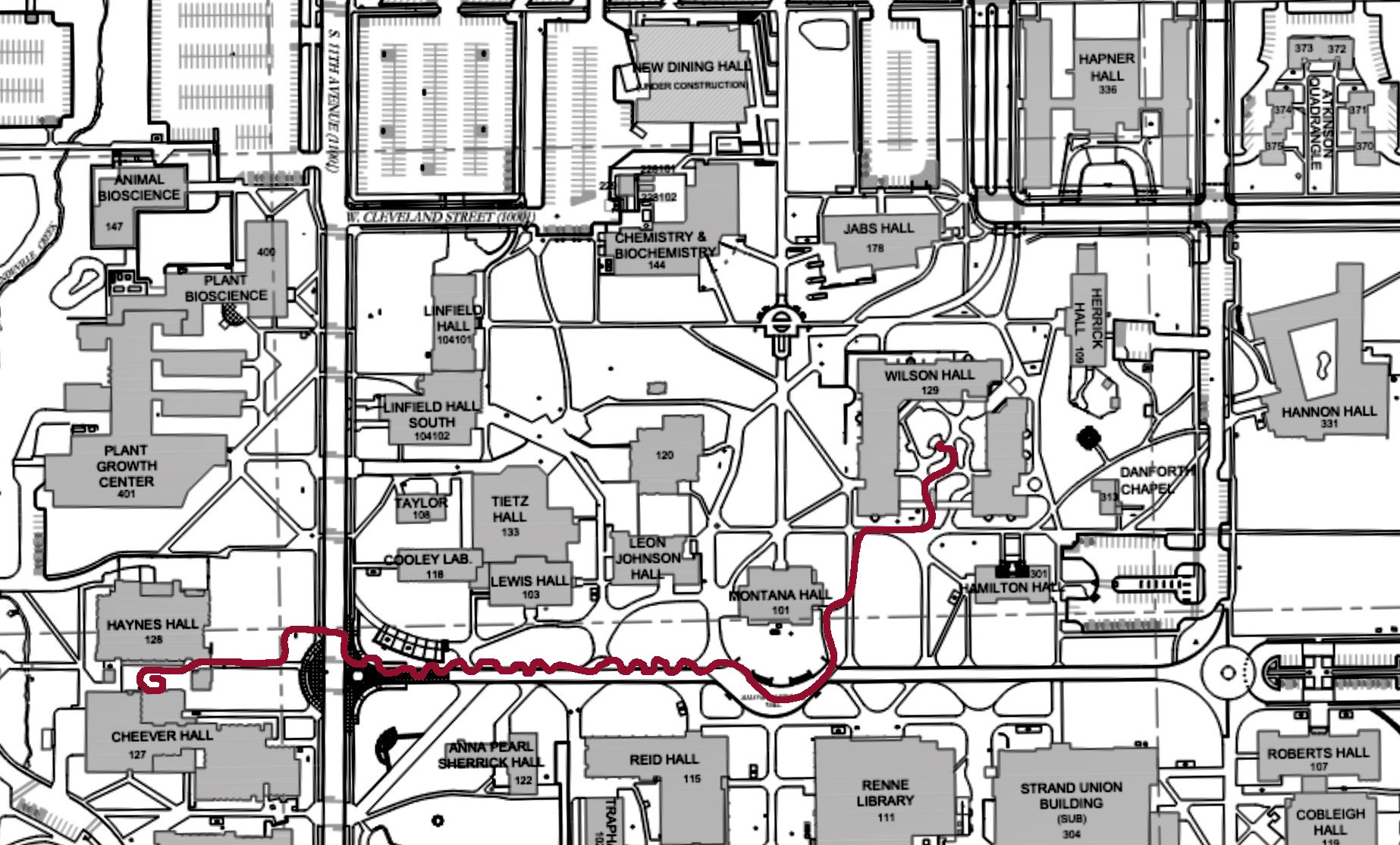
Campus Map Section :: Image – MSU Services

Bridger Canyon Road :: Image – Still from the movie Torn.

Handmade Houses: A Guide to the Woodbutchers Art :: Art Boericke, Barry Shapiro Photographers
It was Friday and my writing class in Wilson Hall ended at noon. Afterwards, I wandered the corridors because I liked to look at the nameplates next to the faculty member’s office doors. Reading the names of the writers, philosophers, and literary professors always made me happy. Maybe they were on the verge of breakthroughs, like a new way to view quality, discovering a new way to describe moving water in their new poem, or the birth of a literary journal. It always felt serious and authentic there and I loved trying to feel it. Then I walked into the courtyard and unlocked my bike under the grove of birch trees.
I rode to the art building because I had to stop by the art department office to drop a form off and ended up chatting with Leola for a few minutes. Leola was the department secretary, office manager, and heart of the place. Like most people in her position, she quietly held most of the knowledge and power. She had the answers for everything you’d ever need to know—not just answers to the paperwork questions from students and faculty, but she could tell a ceramics student what the melting temperatures were for each cone during a kiln firing, why the video equipment had been glitchy lately, the office hours for every faculty member from memory, and when the photo chemicals were scheduled to arrive. She knew everything and everyone.
While I was there, I checked a painting in the painting studio I’d recently started in the corner and walked over to fellow student to say hi.. She asked me what I was up to. “Not much. Just got out of a class. Seeing who’s around and then head home. How about you?” I asked. “My class just ended too. I’m heading home as well. No plans after that.” “Don’t you live somewhere on Bridger Canyon Road?” I asked. “I do. Have you been to our place before?” “No, someone must have mentioned it.” I said. “I’ll just be home later. so stop by if you’re looking for something to do.” “Oh… thanks! That could be a nice ride.” I said. “It’s a big house with a large open porch on the north side of the road. It sits by itself, has quite a few big trees around it and there’s a red mailbox at the entrance to our road.” “That sounds easy to find. I’m not sure I’ll make it, but thanks for the invite.”
I rode home and after I’d eaten lunch and worked for a while, I decided to take her up on her offer. It was a nice day, so, I grabbed my pack, some supplies, and road through town on North Rouse which merged onto Bridger Canyon Road. It was a narrow county two lane with virtually no shoulder in either direction. Cars drove at highway speeds so it wasn’t bike friendly. I was relieved to see the roof of her house rise into view. It had a gambrel roof, a large front porch, with a detached garage on five acres surrounded by Cottonwood, Blue Spruce, and Elm trees. There was a grove of aspen trees on the backside of her house that looked like it was moving as it crawled through the drainage and up the foothills towards Mount Baldy. The mailbox was painted red just like she said. I rode up the gravel road and laid my bike down and sat on the huge front lawn to catch my breath. A few minutes later, a screen door closed behind me, and I turned to see her waving from the porch. I joined her and we sat talking about bike riding, the expansive view back towards town, art, her house and how she ended up there. Eventually we went inside and sat at a long, heavy farm table in the dining area, drank coffee, talked and smoked cigarettes for a couple of hours. The mullioned window light created smokey grids in the air above us floated and changed when the light through the windows changed. Her house began to feel more and more familiar like I’d been there before. Maybe like the shotgun house in Somers on the north end of Flathead Lake, a photo from the Handmade Houses book, or the Far Out House back in town. It’s a specific powerful feeling I remember and still count on so many years later.
Songs :: The Blue Man by Steve Kahn, Albatross by Fleetwood Mac, Freeway Jam by Jeff Beck, Something You’re Going Through by Graham Parker, and Good Times Roll by The Cars
© C. Davidson

Journal Cover

Lift :: Ink on Paper – Journal - Private Collection
Song :: Divide and Conquer by Bob Mould, Stay Hungry by Talking Heads, Red Moon by Big Thief, How To Be Invisible by Kate Bush, and Give It (Once in a Lifetime) by Lambchop
© C. Davidson

It’s been hot and dry lately and today was no exception. My wife was out of town, our daughter was working her afternoon/evening shift, and I was home working on the exterior windows of our house. As usual, it involved scraping, slicing, picking, and power sanding with 40 grit sanding disks on the sashes and sills. 40 grit removes paint quickly and if I stop paying attention will change the shape of the wood in seconds too. I was feeling a bit low after lunch. Maybe it was my exhausting news feed.
Most of the time though, the Remain in Light album is the answer to everything, so, I tapped the icon, inserted my ear buds, climbed the ladder and started to grind. I quickly got into a physical groove and began to feel better. Five feet off the ground and a couple of songs in, I was suddenly transported to my second studio apartment in Providence. It was in a three-story brick house that had been modestly grand in 1870. By the time I lived there, one hundred-fifteen years later, it’d fallen into disrepair and was subdivided into eight apartments. Each apartment included a beautiful architectural detail that made it interesting, and a constant parade of mice and cockroaches which made the place feel like Federalist Grunge.
While I stripped the wood creating a big, hazy cloud of paint and wood dust, I was also standing on a parquet wood floor, behind my desk chair, facing my drafting table with pages of writing on yellow legal pads, walls covered with sheets of tracing paper, filled with notes, grids, icons, and images. The afternoon light streamed in from the Palladian window, which lit up an eight-foot freestanding Doric column behind me, painted in mint blue with a white base and capital.
Sometimes then is also right now. Whether I’m on a ladder here, or standing in an apartment there.
— — — — — — —
“Daydream transports the dreamer outside the immediate world to a world that bears the mark of infinity.” Gaston Bachelard–The Poetics of Space
— — — — — — —
Songs :: Take Me To The River, Making Flippy Floppy, and the entire Remain In Light album by Talking Heads, More Than This by Roxy Music, Rebel Rebel by David Bowie, Legendary Hearts by Lou Reed, and Brick House by The Commodores
© C. Davidson

White Buffalo–Yellowstone :: Photograph – 2009 – Size variable

Yellowstone :: Photograph :: 2009 – Size variable
— — — — — — —
“If you want to understand America, start by looking out the window.” Lee Friedlander
— — — — — — —
Songs :: Grizzly Man by Richard Thompson, Two Lane Highway by Pure Prairie League, I Robot by The Alan Parsons Project, I Remember by Robert Glasper, and Hejira by Joni Mitchell
© C. Davidson

My wife and I usually play pickle ball at two different sets of courts located in two different city parks. Both locations accommodate tennis and pickle ball, use the same net, and are delineated with different lines. Our favorite is at one end of an idyllic neighborhood park near the bluffs in Saint Paul, and across a winding street from a large K-8 school. The courts are enclosed on four sides by a ten-foot chain link fence which is lined on the outside with flowering apple, pine, maple, and elm trees. Clusters of larger trees further out into the park create individual rooms with pods of shade, and still allow the sunlight between them to bathe the lush green grass.
We played there recently and during our water break between games, I walked to a far corner of the court to gather balls that had collected. As soon as I entered that small area of shade next to a group of pine trees and deep grass outside the fence, I was instantly transported to my grandparents’ house in Great Falls. I was nine years old in a secret corner, on the shady side of their home. It was located on the north side of their garage, under the broad canopy of the apple tree, where I squeezed through the dense hedge. The other side was mysterious and unsettling like an in-between place in the Hayao Miyazaki movie Spirited Away. I found myself sitting for a long time on a short brick ledge, in the cool air, stiff limbs, and lush leaves, cushioned by thick, ancient moss. I was on the verge of discovering something huge that day, an experience of a place that felt like a different world. I never told my grandmother, or anybody else, where I’d disappeared to because it was mine, and I couldn’t explain where I’d been anyway, what I’d seen, or how it made me feel.
It all returned in the coolest and greenest corner of our court. It was immersive and became even more complex because as I stood there, it began to link other moments. I couldn’t have imagined that the smell of damp pine, grass and apple blossoms could transport me to my grandparent’s secret hedge, and then continue to unfold into something even bigger.
— — — — — — —
“Daydreams transport the dreamer outside the immediate world to a world that bears the mark of infinity.” Gaston Bachelard–The Poetics of Space
— — — — — — —
Songs :: Spirits In the Material World by The Police, Keep That Same Old Feeling by The Crusaders, True to Life by Roxy Music, The Stable Song by Gregory Alan Isakov, Blumenkriege by Sei Still, and Series of Dreams by Bob Dylan
© C. Davidson

— — — — — — —
For Delilah, Kristin, Bill and Ella
— — — — — — —
Songs :: World Gone Strange by Andy Summers, I Don’t Know by Beastie Boys, How To Be Invisible by Kate Bush, Delilah by Marshall Crenshaw, and Very Temporary by Bob Mould
© C. Davidson

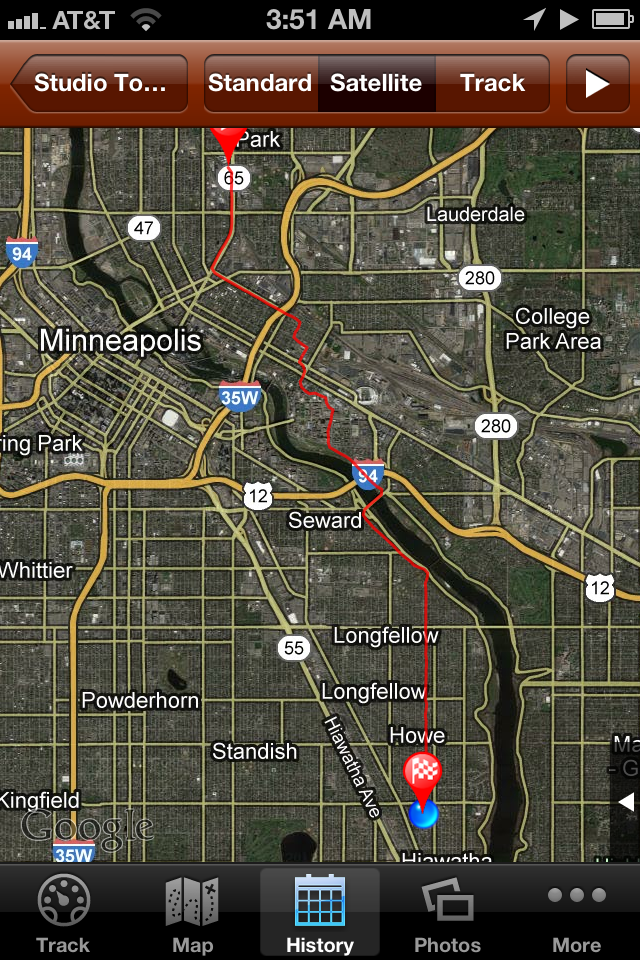
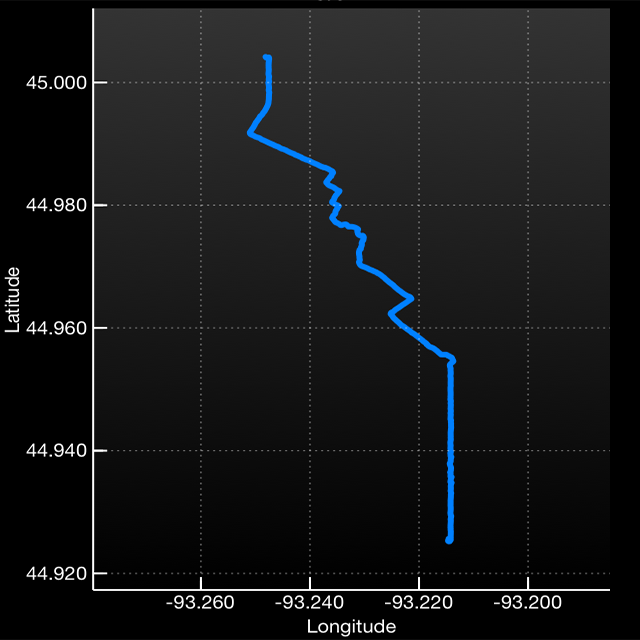
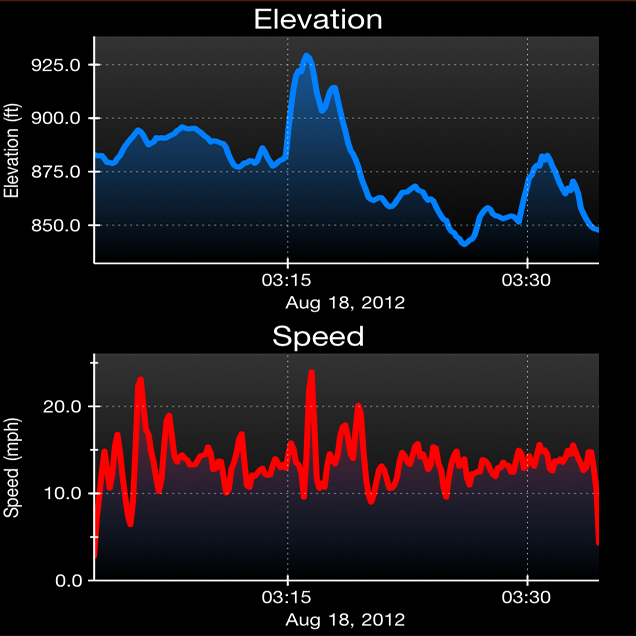
Riding home from the studio was always best after 3:00am. A few things determined whether it was a typical ride, a challenging ride, or an exceptional one, including weather, wind, activity in the university district, my mood and hunger level. Sometimes I didn’t feel like riding home, but short of calling a cab, it was the only way back. Summer night rides were the best part of my day. It was often warm and humid at that hour which made it smell like Florida. After shouldering my bike from the second floor to the loading dock outside, I situated my gear and chose music for the ride. I usually selected something upbeat, like Jeff Beck, Tom Scott, or Tom Petty. That night I chose the Nebraska album by Springsteen. I tolerated the first three songs but eventually lost momentum, like my tires were cement. I hit both brakes and skidded to an abrupt stop and chose something else.
Five Rabbits :: The middle third of the route is through the university district, which includes a huge green space with shade trees and a sidewalk that splits it diagonally. I had a lot of negative chatter in my head all day including the ride home — enough negativity that I spoke out loud. “Yeh? Well, if you’re real, prove it, make a rabbit appear.” Poof. A rabbit appeared almost immediately on the grass to my right. I was surprised, but I frequently see rabbits on my rides at night, so I wasn’t impressed. “Show me another.” Poof. Another rabbit appeared ahead to my left. “OK. That’s a coincidence. Show me another.” Poof. Another rabbit appeared. Now I was startled. “This is a coincidence. If you’re really listening, do it again.” I rode a bit further and Poof, Poof, there were two more rabbits sitting next to each other. Five rabbits appeared in that space, on command. I told my wife about my encounter the following day and she didn’t think it was a coincidence.
Ronald McDonald House :: I usually rode past the Ronald McDonald House on campus. There aren’t any signs of activity at that hour, but I’d been fooled many times when riding by because there’s a life-size fiberglass statue of Ronald McDonald sitting on a bench by the front entrance. During the daylight hours you can see its bright colors, but in the dark while its back lit from the lobby windows, it looks like an actual person. The children and young adults who stay there have serious medical situations, so they need to be close to the university hospital for long periods of time and this place allows families to be together. Two nights within the same week, I saw two figures sitting on the bench, not just the statue silhouette. As I rode closer, I saw an older man cradling a young child. I waved to them, and the man waved back. From that night forward I waved every time I rode by even if just the statue was present.
Raccoon :: I entered the Seward neighborhood after crossing the bridge that spans the Mississippi River. Five or six blocks ahead I noticed a dark shape in the middle of the road. It could be anything and it was something to pay attention to as I sped towards it. A block away I figured it was a cat and needed to prepare in case it bolted in front of me at the last minute. I’d seen a lot of cats over the years lying in the middle of the road absorbing the last of the heat. As I got closer, I began to yell out and clap my hands. It finally heard me because it started to shift but didn’t move out of the road. Twenty feet away I realized it was a raccoon and as I got close, it turned, faced me, stood up on its hind legs and swatted at me as I passed.
— — — — — — —
“Like a whisper In the dark.” David Byrne
— — — — — — —
Songs :: Night Ride Home by Joni Mitchell, Bad by U2, Strangered In The Night by Tom Petty and the Heartbreakers, Pump It Up and Moods For Moderns by Elvis Costello and the Attractions
© C. Davidson
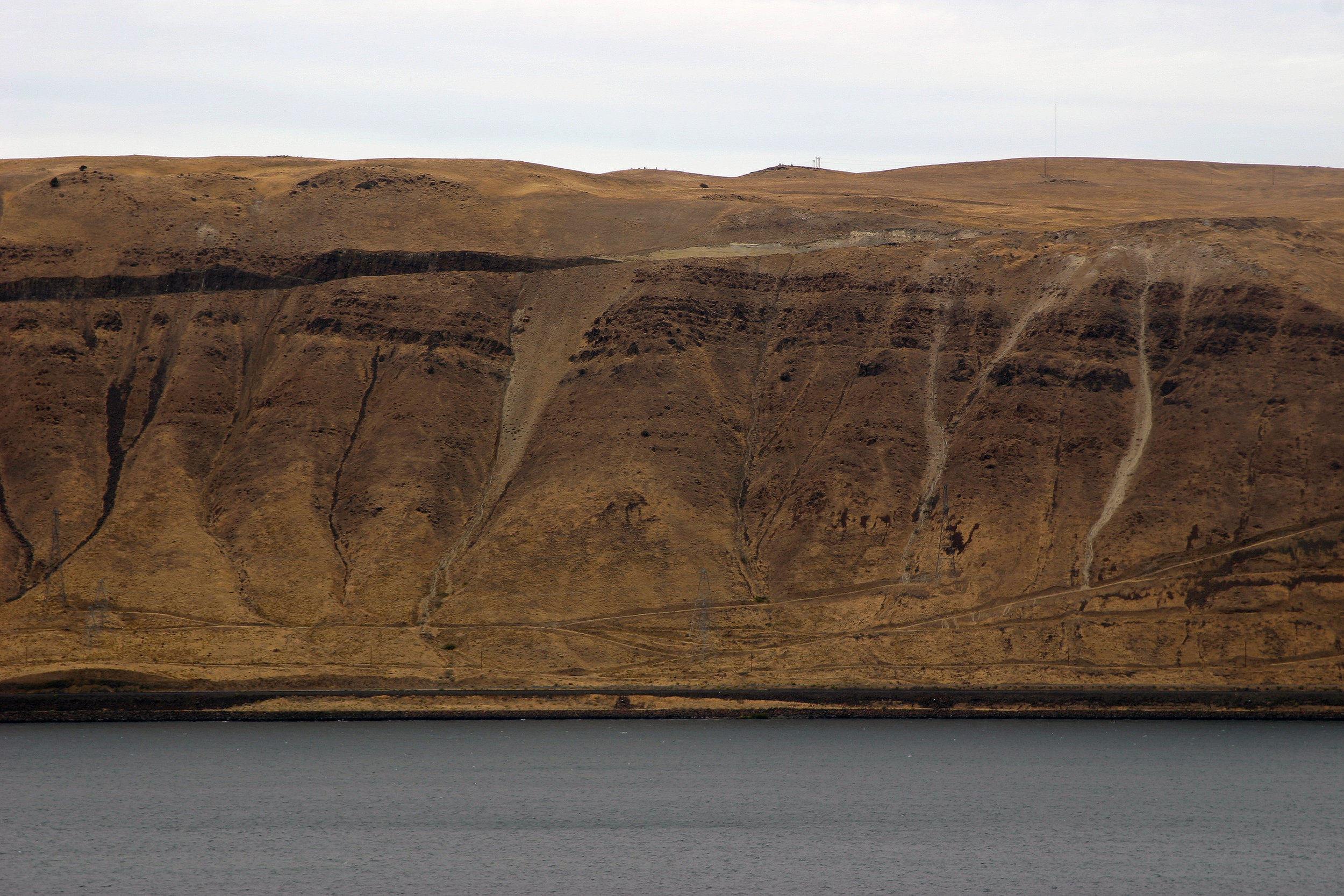
Columbia Gorge :: Fall
Songs :: Sons and Daughters by The Decemberists, Once Upon a Time In the West and Follow Me Home by Dire Straits, and Radio Nowhere by Bruce Springsteen
© C. Davidson


I was hypnotized by the flames and drowsy from the heat of the stone fireplace because I sat so close to it. My feet rested on a wooden stool that was even closer, so I couldn’t keep them there very long because my flip flops were hot and thought they might melt. I didn’t know for certain, it hadn’t ever happened before, but they looked like they were starting to change shape, and my feet were hot, so I scooted back.
Our log cabin rental felt like a small lodge. It smelled like one too — good smells like wood, fire, smoke, and evergreen. It had huge roof timbers, log cross beams, heavy wood chairs and table, two vintage couches upholstered in leather, a couple of woven rugs on the floor, antlers, mounted walleyes on the walls, and large windows that were divided into thirty-two square panes. It was built in the early part of the twentieth century and felt like it could be in a national park, or a scout camp somewhere.
The light was low because there were no overhead fixtures. The main room had a few areas of warm ambient light scattered throughout from lamps, and the expansive glow of our fire. When I looked up from my drawing and my wife looked up from her book, our eyes met. Hers reflected orange just like the flames in front of us. I knew she was warm and hoped she was happy. Except for the sound of her turning pages, my drawing, and the crackling of the fire, it was quiet. Quiet enough that if we listened hard, we could hear wolves howling in the distance all night long. They were faint, but they were out there.
The moon slowly moved across the expanse of windows shifting the color of the glass from black, to dark blue, to light blue, before it disappeared behind the shore trees on Burntside Lake. We fed the fire until after midnight, when the wood I’d split was almost gone. Eventually we slipped into our hand-built log bed with a soft, queen size mattress, a thick homemade quilt, and pillows with perfect densities. We left the bedroom door open so the sound of the waning fire and occasional howling would soothe us while we slept.
Songs :: You’re Gonna Make Me Lonesome When You Go and Buckets of Rain by Bob Dylan, See the Changes by Crosby, Stills and Nash, Spellbound by Poco, Steady On by Shawn Colvin, and The Book of Love by The Magnetic Fields
© C. Davidson
Songs :: The Revolution Will Not Be Televised by Gil Scott-Heron, Enter Sandman by Metallica, Ohio and Revolution Blues by Neil Young, Fight To Win by Femi Kuti, and Police and Thieves by The Clash,
© C. Davidson

Images :: Google Earth

Marfa, Texas :: Image – Google Earth

Dutton, Montana
I’ve never been to Texas. My wife has visited Texas a few times, her parents lived there decades ago, our daughter has a good friend outside Dallas, and I know someone who spends half the year somewhere in the state. I’ve only heard stories about it, or watched movies and television shows based there. I’ve seen a lot of images over the years too, horrifying and soothing. I’ve read articles about Austin, and I used to watch Austin City Limits frequently. When I see pictures of Marfa’s main streets though, it feels like a bunch of small Montana towns I know — Dutton, Havre, and Big Timber — some with a few hundred people, and some with a couple of thousand.
I was listening to a podcast and the show’s celebrity guest mentioned Marfa, Texas. He’d been there recently and spoke about how much it’s changed from when he visited a few decades ago. It’s become a remote outpost for artists and galleries, initiated by Donald Judd in the 1970’s, who moved in and shifted its energy. Even with that kind of contemporary change, I still wonder how anything can be sustained in towns that size. Then I remember that most small towns didn’t begin because of retail opportunities for the residents, or tourists like me, unless they have a Corn Palace, or a giant truck stop near the highway. They exist because it’s a place for the people who live nearby to drop off crops, buy propane, and replenish their water supply — they’re literal weigh stations. If you look to the edges of the towns, there’s usually a cluster of silos, and depending on the size, maybe even a few clusters of silos. Sometimes the smallest towns only include a hardware store, a small tavern, maybe a cafe, and a couple of gas pumps. If it’s larger, there might be a post office, a bank, a courthouse, a Chinese, or Mexican restaurant, with surprisingly great food, and an insurance agent who occupies a vacant storefront one day a week because they travel from town to town.
If a local farmer, or rancher, drives through and decides to see if anybody they know is there, they rarely need to go inside anywhere to check who’s there. They know just by identifying the trucks parked out front. People often work alone when they live in isolated places like this, so conversation is welcome, even craved sometimes. You might see two trucks parked in the middle of main street next to each other, facing opposite directions, without their engines running, while the occupants talk. Conversations that last awhile and typically revolve around the weather, commodity prices, their families, and updates on the repairs each of them has been making to their equipment. It’s hard to keep everything that’s on their minds to themselves. It’s hard for their spouse, or their kids too, to be burdened with the same worries and frustrations day after day, so, they drive through town looking for others to talk with.
So, I can imagine what Marfa might feel like without visiting it. The air might be thicker and smell different than in Dutton. The color of the soil might differ, construction materials and building silhouettes might be different too because it’s Texas, not Montana. Except for all of the painted stars, cement stars attached to exterior walls, and forged steel stars hanging from mobiles around Marfa, I think its heartbeat is just like Dutton’s.
Songs :: Transcendental Blues by Steve Earle, Out of Touch by Hall and Oates, My Hometown by Bruce Springsteen, All My Days by Alexi Murdoch, and On The Nature Of Daylight by Max Richter
© C. Davidson


Songs :: Stand By Me by Ben E. King and Downbound Train by Bruce Springsteen
© C. Davidson

Remnants Postcard Stack:: Postcard Collective – Summer 2021 Exchange :: Burn completed. Ready for addressing and postage.
Songs :: God’s Gonna Cut You Down by Johnny Cash, Street Hassle by Lou Reed, Ain’t That So by Roxy Music, Refugee by Tom Petty and & Heartbreakers, and Willin’ by Little Feat
© C. Davidson
I did leave my heart in San Francisco. I finally know what Tony Bennett meant. I left it all over the bay area and even further north. A nephew was getting married which was why we were there. We stayed in a Walnut Creek hotel with other family members, for a few days, and on one of those days, my wife, daughter and I drove into San Francisco. We went down the crookedest street in the world, we glimpsed the Painted Ladies in the distance, walked on the Golden Gate Bridge, wandered through Chinatown and hiked the hilly streets of downtown. We walked to the base of the Transamerica building too. I had to see it up close. However much of an architectural novelty it is, it’s iconic and I’ve been transfixed with it since I was a teenager. My interest was reinforced when the Doobie Brothers used an image of it on their album cover, Livin’ on the Fault Line.
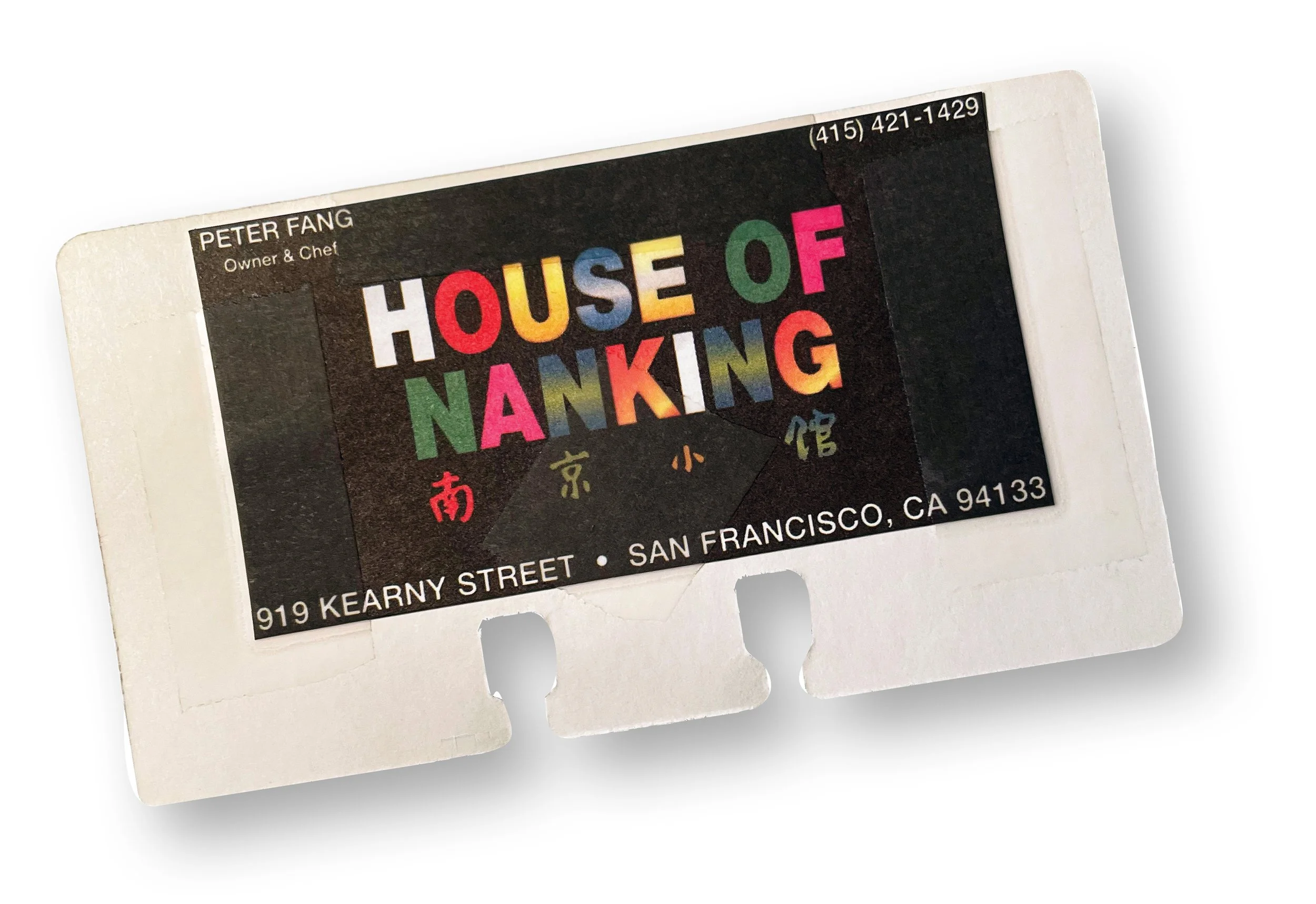
After a couple of hours, we got hungry, so my wife researched options for lunch. We were flexible, as long as it was tasty, nearby, and Chinese. The one she identified was House of Nanking. It had great reviews, off-street parking and served what we craved. After inhaling our meals, we relaxed with tea and fortune cookies. Afterwards, we drove north across the Golden Gate Bridge and parked near the end of it, then walked back onto the bridge to the halfway point with a lot of other people. I forgot the bridge was orange because its color is suddenly secondary to the overwhelming view in every direction. The force of the wind was significant and a bit unsettling at first, so I picked our daughter up in my arms. She had a better view too and when I did, the wind hit her face, so she squinted into it. The sea air seemed to soothe her. After half an hour, we walked back to the car and drove up the west side of the bay, across the Richmond-San Rafael Bridge, and south into Berkeley for sushi.
Two days later we drove north with other family members to Point Reyes and to the houses we rented in the woods. We had two that were next to each other, a hand built hot tub with a rustic changing area between them, and a few wind shaped Cypress trees that formed a natural room. The bigger house looked like one from the Handmade Houses: A Guide to the Woodbutcher's Art book. I imagined it being built by a young couple who’d escaped the city in the late 1960’s. The other house was smaller, simple and modest, like it had been built decades later to accommodate the overflow during family gatherings. While we were there, we spent time on a beach along Drakes Bay, visited the Tule Elk herds on Tomales Point, and roamed a few small towns for food and souvenirs. One mythic town we didn’t have time to visit was Bolinas. I often imagine because my wife has been there before with friends, Richard Brautigan lived there, and Anne Lamott writes about it. Our trip was like a lot of other trips we’ve taken. It’s dreamlike, a little hazy, and even surreal because at some point we suddenly jet out of it which doesn’t allow for a gentle transition. When the glow begins to fade weeks later, months if I’m lucky, I try hard to hold on and hope some of it will remain.
“You know what? I know what he means. It’s like a childhood memory thing.” From Don’t Look Up
Songs :: Stride of the Mind by Patti Smith, Sands of Time by Fleetwood Mac, I Left My Heart in San Francisco by Tony Bennett, and You’re Made That Way by The Doobie Brothers
© C. Davidson

Rail and Pennies — NE Minneapolis

Train — NE Minneapolis

Songs :: Copperline by James Taylor, Runaway by Bonnie Raitt, Sweet Emotion by Aerosmith, Roam by The B52’s, Something You’re Going Through by Graham Parker, and Long Train Runnin’ by The Doobie Brothers
© C. Davidson

Bear Trap Canyon Route – 1983 :: Image-Google Earth

Downtown Providence :: Image-Google Earth

Super Target – 2021
Once I crossed the canal that’s fed by Narragansett Bay and the Atlantic Ocean, I sped into the narrow streets of downtown on my black one-speed, with electric blue rims, and pierced the canyons like a blade, just like I did in Bear Trap Canyon with friends eight months earlier. It was usually gray, rainy, or just after dusk when I rode this brief route, the opposite direction from campus and everything connected to it. It was impossible to completely escape though, because there were ghosts everywhere. I brought a few with me from Montana, some were new and mumbled near the window outside my first studio apartment on Congdon Street. Others had been roaming the city for centuries.
When I finally arrived at Dunkin’ Donuts, I did a serpentine skid to a stop, swung my leg over and locked the bike to the nearest street sign all in one motion. I went inside and waited near the bright display case and scanned the doughnut options. A well-dressed elderly man sat alone at the far side of the u-shaped counter partially blurred by steam from his coffee. He stared straight out to Union Street while three other customers were being helped by an employee speaking softly to them at the end of the counter. Everyone felt like regulars while I was ecstatically anonymous. I purchased four doughnuts and a small cup of coffee, exited, leaned against the glass windows, ate a cake one with chocolate frosting and sprinkles, and finished the hideously weak coffee. I kept the other three doughnuts in the waxy bag and slipped them into my day pack. Those were for the wee hours in the studio and photo lab. Riding solo to this corner, in this part of town, and then meandering slowly back to campus was a huge distraction from the studio chaos I’d left an hour before.
Recently, I found myself at Super Target in Saint Paul looking for the best deals on packaged ground coffee. I’ve noticed the bright colors of the Dunkin’ Donuts bags positioned off to the side for years, pushed out by elegant brands, bigger brands, and local roasters. I assumed that the coffee they sold in these bags would be just as weak and disappointing as it was in downtown Providence decades ago. On this day though, they were placed in the center of the coffee shelves and on sale, two for one, so I reluctantly grabbed two of the darkest grinds they had. I stood there holding the slick bags and flashed on moments from those rides and the significance of everything that was shed and gathered in both canyons almost forty years ago — remembering just how fluid everything still is.
— — — — — — —
“Then in the Arctic half-light of the canyon, all existence fades to a being with my soul and memories and the sounds of the Big Blackfoot River and a four-count rhythm and the hope that a fish will rise.” Norman McClean – A River Runs Through It
— — — — — — —
Songs :: Burnin’ Streets by Joe Strummer & the Mescaleros, Several Styles of Blonde Girls Dancing by Martha & The Muffins, Smalltown Boy by Bronski Beat, Times Like These by Foo Fighters, Take Me To The River by Talking Heads
© C. Davidson

Flathead Lake, Montana :: 1960’s
Songs :: Pictures of You by The Cure, Up From A Dream by HAIM, Landslide by Fleetwood Mac and The Smashing Pumpkins
© C. Davidson

Mercury Monarch

Missouri River Bluffs at Night
Music influenced most of my experiences during junior high and high school—Thursday night Key Club meetings, Friday night football games, choir festivals, and hiking in the woods. Music accompanied the view over the Missouri River gorge towards the Rocky Mountain Front and Canada too — exactly where my friend and I were parked. It was dark and the moon had set, so it felt endless through the car windows, with just enough ambient light to define the dim edges of things. Earlier that week while I was sitting in my history class waiting for it to begin, J. walked over to my desk, squatted next to me, and quietly asked if I’d like to go out sometime. My jaw must have dropped. I assumed she was messing with me because it was so random, but as I looked at her she seemed serious. “Um… sure” I said. “How about Saturday night. Are you free?” she asked. “Yeh. I think so… sure… I think… I’ll have to… yeh… Yes.” I said. “Great! Maybe let’s talk on Friday and figure something out”. “OK” I said. She smiled and went back to her desk. I didn’t know her, and she didn’t know me, but we had mutual friends and some common interests, so we might have things to talk about. I’d noticed her in this class, in the hall by our lockers because they were near each other, and sometimes in the lobby of the performing arts building.
The following Friday we figured out the plan and eventually found ourselves parked in my parent’s brown, four-door, Mercury Monarch way outside of town after we’d seen a 9:30pm movie. I don’t recall what the movie was, but I remember sitting next to her in the theater. After the movie let out two hours later, we drove awhile and eventually found a good spot high above the coulees facing the falls on the Missouri River. We had all the windows open, so the smell of damp sage outside the car from an earlier rain, drifted inside. We sat in the front seat for hours, listening to the radio, smoking, drinking, laughing, and talking about everything for the very first time. We connected easily and became friends quickly, before we sank into the beige vinyl seats. I took a lot of risks driving my parent’s cars into places like this, rugged river bluffs and two-track mountain roads were all best suited for four-wheel drives, not the family sedan, but I didn’t own a four-wheel drive, or a car of my own at the time.
Besides our energy, that spot was embedded with lots of historic energy, because in June 1805, the Corps of Discovery spent a lot of time in this area. They had to portage four giant boats and all of their gear around the ‘falls’ on this part of the Missouri River. Ours was the same dimly lit horizon that the Lewis and Clark expedition saw at night. All of them may have hiked through this exact location looking for firewood, foraging for edible plants, hunting, and keeping a watchful eye on their new, unpredictable surroundings. They’d been trespassing into occupied territory during their entire journey, including this place. Every tribe from the Midwest to the northwest knew they were there. Fortunately for them, the indigenous people were mostly helpful and tolerant. Sacajawea was an integral part of the Corps too and was frequently responsible for their survival. Some have even written that she had saved their lives on more than one occasion. She may have stood where we were parked too, hauling her baby and her gear across the wild prairie. It felt a little wild that night with my friend too. It wasn’t 1805 wild, but It was a Saturday night in 1977 wild.
— — — — — — —
“Fly me high through the starry skies
Maybe to an astral plane
Cross the highways of fantasy
Help me to forget today's pain” Gary Wright
— — — — — — —
June 13, 1805 – Lewis and Clark Expedition Journal
Anxious to prove he’s right, Lewis scouts ahead of the rest of the ‘Corps’ and is overjoyed (at first) to find the Great Falls, describing them as a “truly magnificent and sublimely grand object, which has from the commencement of time been concealed from the view of ‘civilized man’*.
But it soon becomes clear that the portage (carrying canoes over land) around the Great Falls is going to be far more difficult and will require more than the one day he planned. To help with the challenge, the men fashion crude wagons from felled trees and drag the canoes and equipment across miles of unforgiving, cactus-strewn terrain.
“It takes them almost a month and a half to take all of their gear 18 miles,” says Buckley. “It’s probably one of the slowest parts of the whole trip.”
*Unsettling view of a white man.
— — — — — — —
Songs :: Dream Weaver and Love Is Alive by Gary Wright, I’m Not in Love by 10cc, Hello It’s Me by Todd Rundgren, Wishing You Were Here by Chicago, Baby Come Back by Player, Dust In the Wind by Kansas, Venus and Mars by Paul McCartney, and Lowdown by Boz Scaggs
© C. Davidson

In Goldenrod :: 28th Anniversary – Franconia
Songs :: In Your Eyes by Peter Gabriel and I’m Gonna Be (500 Miles) by the Proclaimers
© C. Davidson